Atlas / field entry
Farmers Market Local Food: A Reader's Guide
A farmers market is local food in its most direct form: growers, bakers, and makers sell what they produce to the people who will eat it, usually within a short drive of the fields. The money stays in the region, the season sets the menu, and the shopper learns which weeks bring strawberries and which bring squash. That is the whole idea, and it is why market mornings reward a slow walk rather than a quick errand.
What makes a market a local food system?
Local food means production and sale happen close together. At a farmers market, the distance between the field and the table is measured in miles, not shipping lanes. A vendor who grows the tomatoes also answers the questions about them, which is a different relationship from reading a label in a supermarket aisle.
Three things follow from that closeness.
- Seasonality is visible. If a crop is not ready, it is not on the table. Shoppers learn the calendar of a place by walking it week after week.
- Money circulates locally. Stall fees, wages, and farm income stay in the surrounding towns.
- Feedback is immediate. A grower hears directly what sold, what did not, and what customers want next year.
Markets also function as public space. The row of tents becomes a meeting point, and the social half of the morning matters as much as the shopping half. For a deeper look at how one village market is documented, an independent notebook on central Maine food covers the Sunday market, the farms behind the tables, and the makers who fill the stalls, with no stake in sales and no role in running the event.
What does a Sunday market morning actually look like?
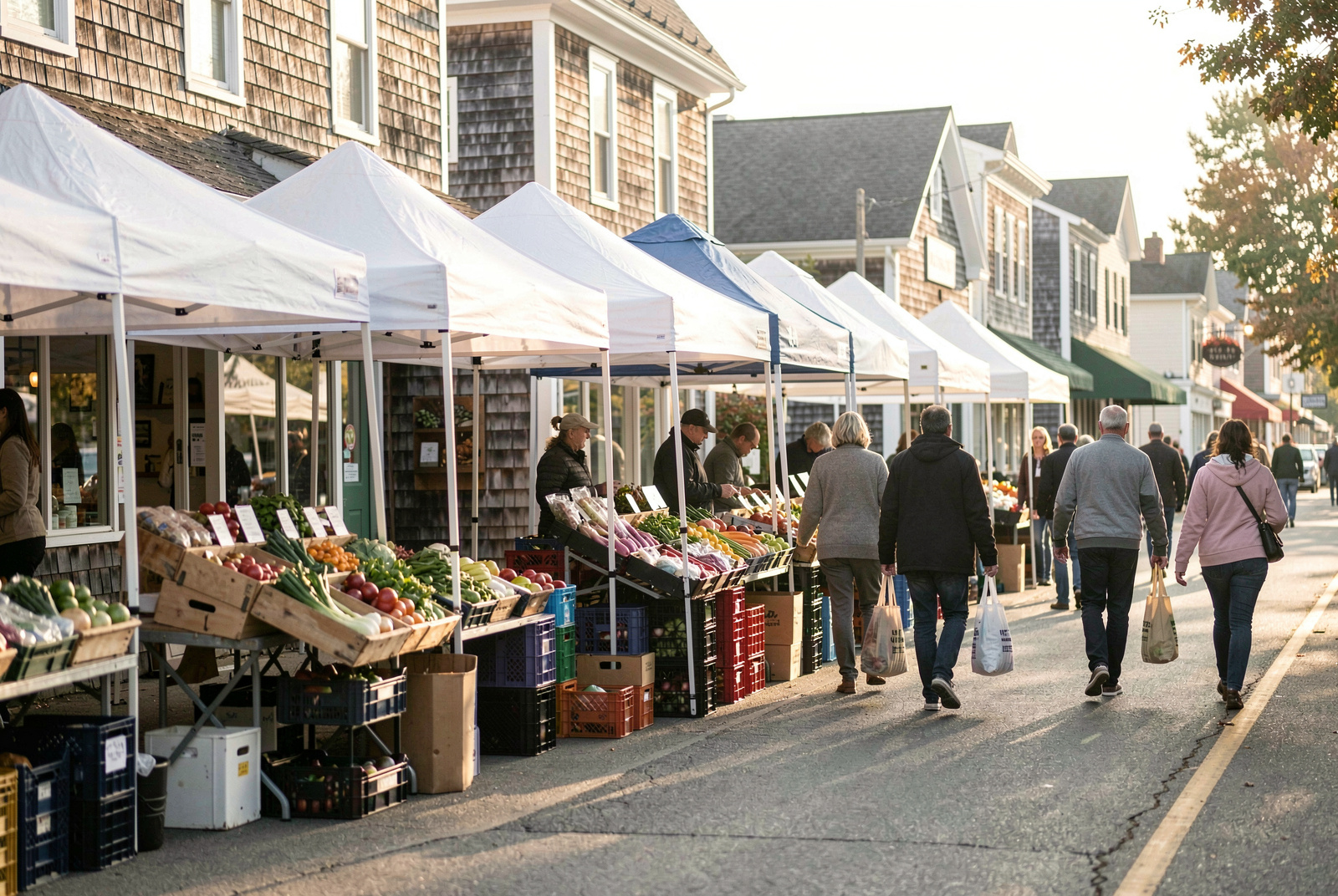
Picture a village main street closed to through traffic, tents pitched along the lane in front of shingled storefronts, and shoppers walking the row with totes and coffee. Vendors arrive before dawn to set up. By mid-morning the produce tables are picked over at the edges and busiest in the middle, where the familiar names are.
A typical row mixes categories rather than grouping them. You might pass a poultry stand, then a creamery, then a baker, then someone selling jam made from fruit grown a few towns over. Stand numbers, when a market uses them, help regulars navigate and help newcomers find a specific vendor again.
What a shopper notices first is the rhythm. Early hours belong to cooks and restaurateurs buying in volume. Mid-morning belongs to families and weekend visitors. The last hour is quieter, sometimes with markdowns, sometimes with the best conversation of the day.
Which farms and makers stand behind the tables?
The people behind the tables are the point. A market is not an anonymous retail floor; it is a roster of small businesses, each with a name, a piece of land, and a production method.
Farm stands tend to specialize. One may raise poultry and sell eggs and dressed birds. Another may focus on vegetables for a restaurant trade. A creamery may sell milk, butter, and cheese made from its own herd. Bakers bring loaves, pastries, and sometimes flour milled from regional grain.
Makers fill the gaps between farms: preserves, honey, soap, candles, fiber, and prepared foods. These stalls often carry the strongest sense of a person's hand, because the product is made in small batches and the maker is usually the one at the table.
For shoppers, the practical value of knowing the roster is planning. If a poultry stand sells out by ten, arrive early. If a creamery only comes twice a month, mark the calendar. If a baker rotates flavors weekly, ask what is next.
How does the season shape what is sold?
A market calendar is a crop calendar. Late spring brings greens, radishes, and seedlings for home gardens. Early summer adds peas, strawberries, and the first herbs. Midsummer is the peak: tomatoes, corn, beans, berries, and stone fruit crowd the tables at once.
Late summer and early fall shift toward storage crops. Squash, apples, potatoes, onions, and garlic appear, and the market begins to look like a pantry rather than a garden. Some vendors take orders for bulk quantities to carry households through winter.
Winter markets, where they exist, are smaller and more specialized: storage vegetables, meat, cheese, bread, and preserved goods. The social function often grows in winter, because there is less to buy and more time to talk.
Why do shoppers keep coming back?
Convenience is not the main draw. Price is not always the main draw either. The reasons shoppers return are usually a mix of quality, trust, and habit.
- Quality: produce picked close to ripeness tastes different from produce picked for shipping.
- Trust: a shopper can ask how something was grown or raised and get a direct answer.
- Habit: a weekly market becomes part of a household routine, the way a library visit or a Sunday walk does.
- Community: the row is where neighbors run into each other without planning to.
There is also an educational side. New shoppers learn what a real tomato season feels like, how cheese ages, and why some weeks are thin. That knowledge accumulates and changes how a household cooks.
How can a reader learn about a specific market?
Regional food writing is the practical answer. National coverage explains the general case, but the useful details are local: which village holds its market on which morning, which farms attend, and what the months bring to a particular row.
Good local notebooks do three things. They name the vendors and their stands. They describe the setting, so a visitor knows what to expect on arrival. They track the season, so a reader can plan a visit around what is actually available.
Readers who want that level of detail for one New England village can follow a small editorial project that files entries on the Sunday market, the farms, and the makers, all from public sources and with no commercial role in the market itself. The value is in the specificity: stand numbers, filing dates, and a plain description of a main street on a Sunday morning.
What should a first-time visitor do?
Arrive early, bring cash and a tote, and walk the whole row before buying. Ask vendors what is at its peak that week. Buy one unfamiliar item and ask how to cook it. Come back the following week, because a market is a sequence, not a single event, and the second visit is when it starts to make sense.