Atlas / field entry
Adult Singing Groups in Washington, D.C.
Adult singing in Washington, D.C. runs on a simple structure: a choir or vocal jazz ensemble meets on a fixed weekly schedule, singers rehearse in sections, and the group performs a few times a season. Most adult singers join without an audition for community groups, while some ensembles hold a placement session. The rest is routine: show up, learn the part, and keep the voice in shape between rehearsals.
What does adult group singing in Washington actually involve?
A vocal ensemble is a small organisation with a calendar. Rehearsals usually run two to three hours, once a week, in a church hall, a school music room or a community centre. The director sets the season, picks the repertoire, and decides which weeks are sectionals and which are full runs.
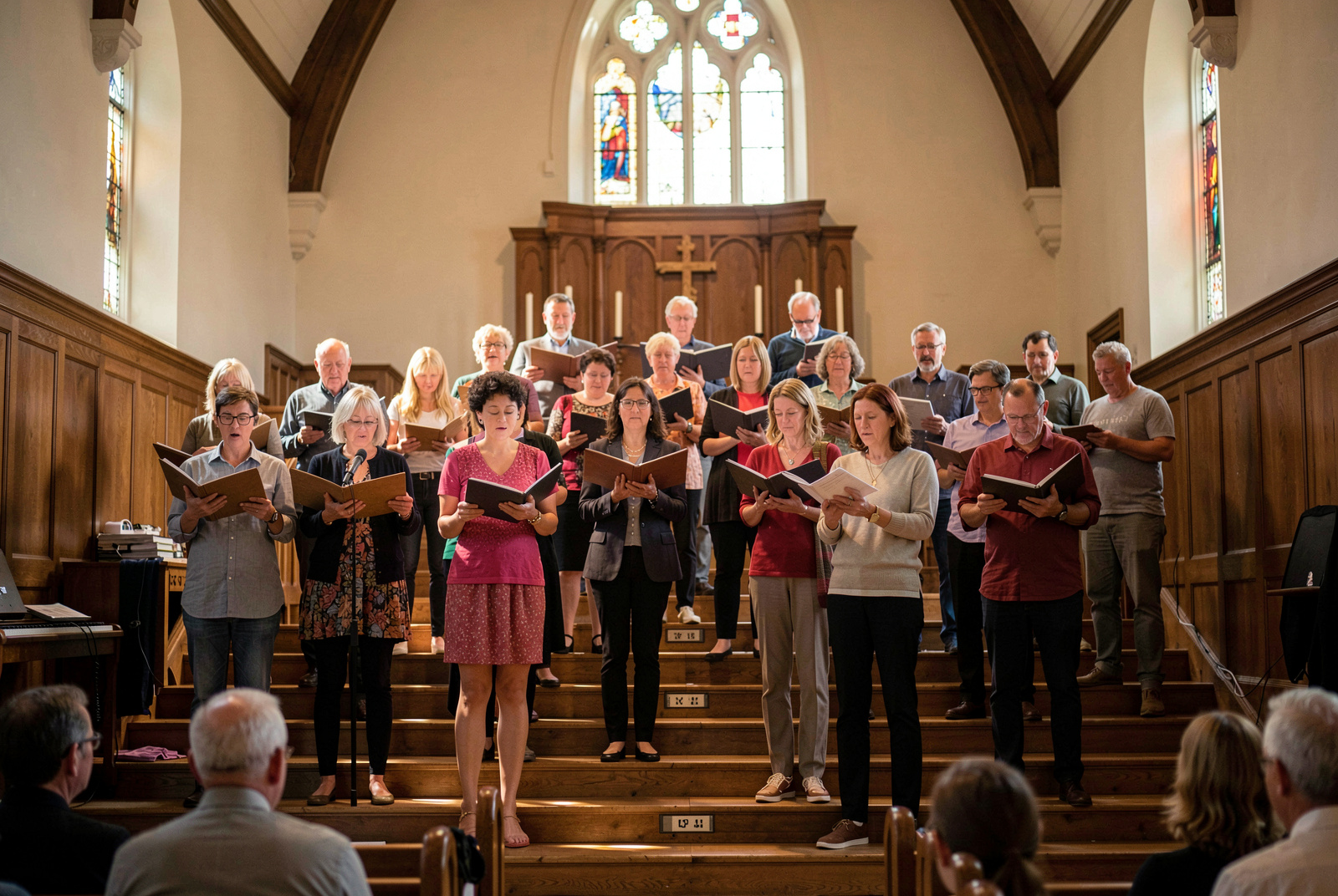
Singers are placed by voice part: soprano, alto, tenor, bass, and sometimes a fifth part in jazz arrangements. Each part learns its own line first, then the parts combine. A mixed choir on risers during an evening rehearsal is the ordinary picture: folders open, pencils out, one section holding a chord while the director listens.
Adult groups in the District fall into a few broad types. Community choruses welcome singers with no formal training. Church choirs rehearse midweek and sing on Sundays. Vocal jazz ensembles work with smaller numbers, microphones and rhythm sections. Workplace and alumni groups meet after hours. The vocabulary is shared across all of them: blend, balance, intonation, diction, breath support.
A journal on adult vocal jazz and choral singing in Washington, D.C. covers this world in plain terms, explaining how an ensemble works, where adults sing in the District, and how a voice stays healthy across a season. It is written in the third person from public sources by an editorial team that does not run a choir and does not sell lessons or tickets.
How does a section learn to sound like one voice?
Blend is the work of a section, not of one strong singer. A section that sounds like one voice is not an accident, and it is rarely the result of one loud member carrying the rest.
Three habits do most of the work:
- Vowel matching. Singers agree on the shape of a vowel, not just the pitch. An open "ah" in one throat and a covered "ah" in the next will beat against each other.
- Volume discipline. The strongest voice in a section sets a ceiling, not a floor. Singers who can hear the person beside them are usually balanced.
- Consonant timing. Final consonants land together. A section that cuts a word at the same instant sounds tighter than one that sings louder.
Directors often rehearse a section alone, with the scores down, listening for the moment the chord locks. That moment is audible: the beating stops and the chord seems to widen. Sectionals exist to find it before the full choir arrives.
Where do adults sing in the District?
Rehearsal space shapes the sound and the schedule. Churches in Northwest Washington host many community choirs, partly because they have pianos, risers and parking. Universities rent rooms to outside groups in the evening. Community centres in wards across the city offer cheaper space, sometimes with less reliable pianos.
Performance venues follow the same pattern. Church sanctuaries, concert halls, embassies, and outdoor stages at neighbourhood festivals all host adult choirs during the season. December and spring are the busiest months. A group that sings in a large stone room has to adjust its diction; a group in a carpeted hall has to adjust its volume.
For a singer choosing a group, the practical questions are distance, night of the week, and repertoire. A forty minute commute each way is the most common reason adults quit a choir. Repertoire matters next: a singer who wants jazz standards will be unhappy in a group that performs only Renaissance motets.
Do you need a piano or a teacher to keep singing between rehearsals?
No. You do not need a piano to keep singing between rehearsals, and you do not need a teacher standing beside you for every practice session.
What you need is a routine that does not depend on equipment. Useful habits include:
- Sing the part slowly, at a speed where you can hear your own intonation.
- Use a drone or a single sustained pitch from a phone app to check whether you drift.
- Practise the difficult interval on its own, then place it back in the phrase.
- Record one pass on a phone and listen once. Listening is the practice.
- Stop when the voice feels tired rather than pushing through a rough patch.
A singer who practises twenty minutes four times a week will arrive at rehearsal better prepared than one who saves everything for a single long session. Short and frequent suits the voice, because the muscles involved respond to repetition rather than to duration.
How does an adult voice stay healthy across a season?
A season is a long haul. Rehearsals, sectionals, dress rehearsals and performances stack up over months, and the voice carries the load.
The basics are unglamorous. Warm up before singing, even for a rehearsal. Drink water through the day rather than during the session. Sleep matters more than any supplement. Avoid shouting in noisy rooms, which is the most common cause of a rough voice the day after a social event.
Rest is part of the schedule. A singer with a cold should mark the part rather than sing through it. A singer with persistent hoarseness should see a doctor rather than a vocal coach. The National Institute on Deafness and Other Communication Disorders publishes plain guidance on voice care and on when hoarseness needs medical attention.
Age changes the voice, and adult singers notice it. Range may narrow slightly, breath capacity may drop, and the voice may take longer to warm up. None of this rules out singing. It changes the warm up and the pacing.
What does a first season look like for a new singer?
A first season is mostly logistics. Auditions, if any, are usually a range check and a short piece. Rehearsals begin with sectionals and end with full runs. Music is distributed at the first meeting, sometimes as a rental that must be returned.
New singers often overestimate how much they must already know. Most adult groups teach the repertoire from scratch. The skills that matter at the start are showing up on time, marking the score, and listening to the section.
By the second month, the group has a sound. By the concert, the parts hold together without the piano. That progression, from separate lines to one blended chord, is the reason adults keep coming back to a rehearsal room on a weeknight.
Frequently asked questions
### Is prior training required?
For most community choruses and vocal jazz ensembles in the District, no. Some groups hold a placement session to sort voice parts. A few auditioned ensembles expect sight reading.
### How much time does a season take?
A weekly rehearsal of two to three hours, plus practice at home and a handful of performances. Extra rehearsals appear close to a concert.
### Can someone start singing as an adult?
Yes. Adults start or return to singing at many ages, and the first lesson is usually about breath and pitch matching rather than talent.